Appearance
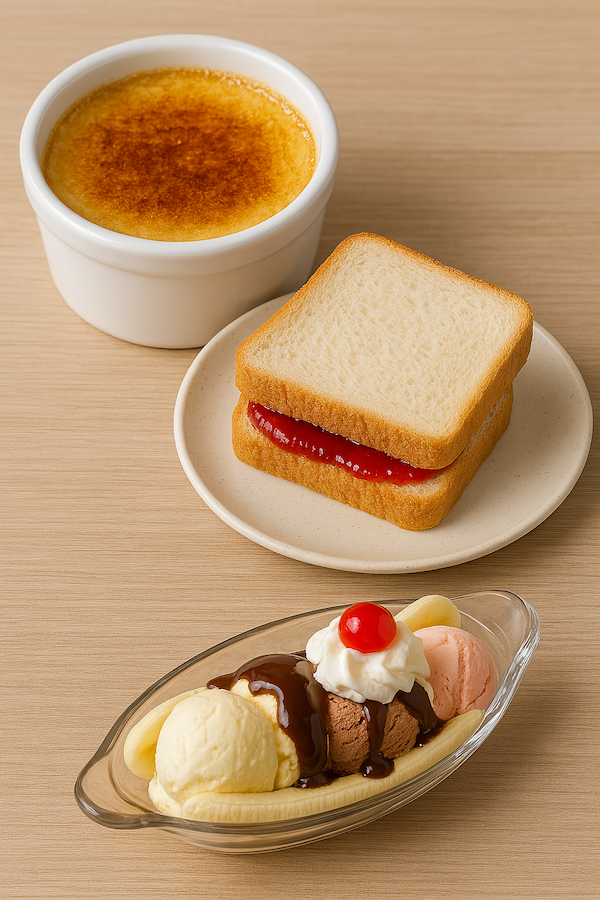
The Earth’s Layers as a Dessert?
Listen to this article
0:00 / 0:00
Some numbers in science just refuse to fit inside my head. The core of the Sun burns at over 15 million °C. The Earth has been around for 4.6 billion years. Nanoparticles measure mere billionths of a meter. I can write those values down, but I can’t really feel them: they’re too big, too small, too far away. And yet one of the strangest, most important parts of our planet isn’t distant or microscopic at all. It’s right under my feet.
We walk over it every day. We build our cities on it, we tunnel through it, and still we hardly ever stop to ask what the Earth is actually made of just below the surface. We say “solid ground” as if that settles it. But what’s really there thirty kilometers down? What’s happening hundreds of kilometers deeper, where no drill has ever reached, where rocks are hotter than fire and time crawls along at the pace of tectonic drift?
That’s where it gets strange and, honestly, wonderful. That’s the lithosphere: the outer shell of the Earth that includes the crust and the uppermost part of the mantle. It isn’t some passive lid sitting on top. It bends, it breaks, it flows (sometimes), and above all, it moves. The lithosphere is cracked into plates, some as big as continents, and those plates never stop: sliding past one another, colliding, pulling apart, occasionally sinking back into the mantle. Every earthquake, every volcanic eruption, every mountain range traces back to what’s going on in this restless shell.
So how do you picture something you can’t see, touch, or measure head-on? You can’t crack the Earth open and pull out a chunk of crust and mantle to watch how they behave. We geologists and geophysicists lean on data instead (seismic waves, rock mechanics experiments, GPS, gravity anomalies) but to really understand the lithosphere as a system, I often need something more intuitive. And sometimes, oddly enough, the most intuitive comparison comes from the dessert menu.
Dessert Time: Edible Earth Models
To get a feel for how the lithosphere is built, scientists have reached for something fun, and surprisingly effective: desserts. These edible analogies take a tangled set of concepts and make them approachable, even memorable.
Let me walk you through them:
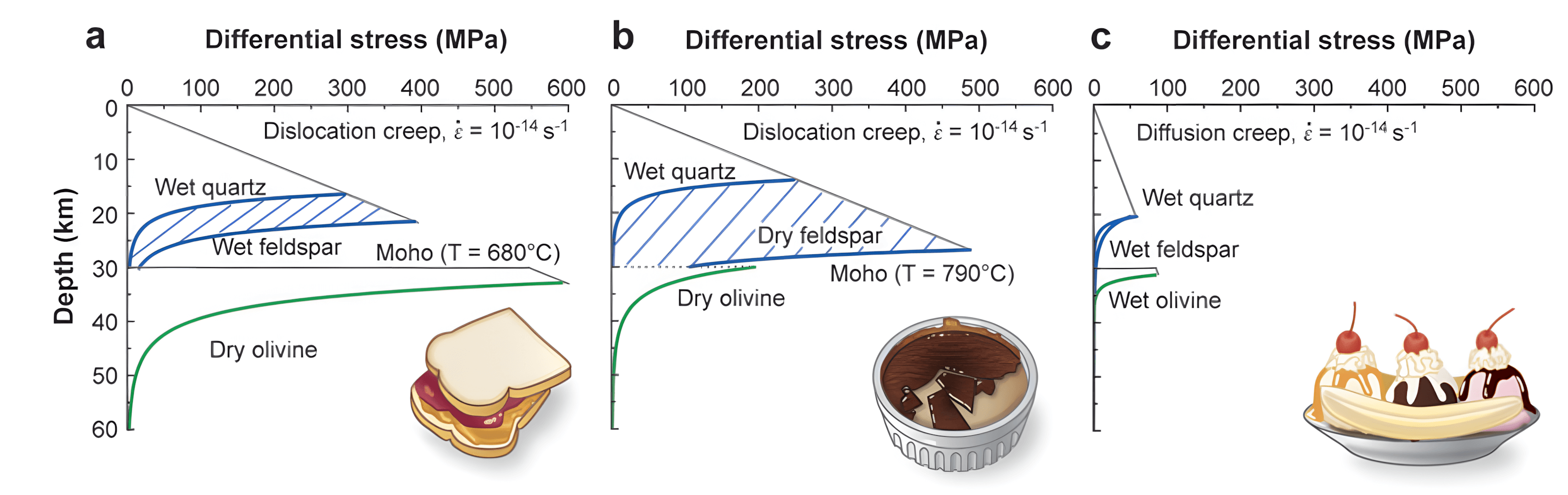 Adapted from Bürgmann and Dresen (2008), this figure illustrates the end-member types of lithospheric strength profiles discussed in their study. Differential stress is used here as a proxy for rock strength.
The Crème Brûlée Model
Picture a crème brûlée: a crisp, brittle sugar crust on top of a soft, pliable custard. That two-layer setup stands in for a strong upper crust (or sometimes the whole crust) sitting above a weak upper mantle. Tap the sugar gently and it flexes: that’s elastic behavior. Press too hard and it cracks: brittle failure. That, in a nutshell, is how earthquakes work.
This one comes in handy for tectonically active regions, where the mantle is thought to be the main weak zone beneath a strong crust. There are a few variations, depending on whether just the upper crust is strong or the entire crust is, but they all share that telltale weak upper mantle. The idea has been used to explain crustal strength profiles in a number of geodynamic studies (e.g., Bürgmann and Dresen, 2008; Jackson et al., 2008).
The Jelly Sandwich Model
This one literally has more layers. Picture a sandwich: strong slices of bread (the upper crust and the lithospheric mantle) wrapped around a wobbly jelly filling (the lower crust). The claim here is that the lower crust is mechanically weaker, deforming more readily than the strong layers above and below it. Under stress, the jelly can stretch elastically and then give way, while the bread bends but holds together.
The jelly sandwich has been used widely to explain lithospheric strength profiles across all sorts of tectonic settings. It was first proposed by Chen and Molnar (1983) and later expanded by Burov and Watts (2006). It’s still a go-to picture for thinking about continental deformation, especially where the lower crust might act as a decoupling layer.
The Banana Split Model
If the crème brûlée and the jelly sandwich feel a little too tidy for the actual mess of tectonics, the banana split steps in. This dessert captures a fragmented lithosphere: individual blocks of crust and mantle (the scoops of ice cream) separated by deep fault zones (the melted, fluid-filled gaps between them). As the ice cream softens, those boundaries weaken, much like real tectonic plates do along transform faults and rift zones.
Fluid, water in particular, matters a lot here. It lowers the strength of rocks and ramps up deformation, especially at plate boundaries. I find this model useful for picturing big, long-lived structures like the San Andreas Fault or the Alpine Fault in New Zealand.
So... Why ?
Each model (the crème brûlée, the jelly sandwich, the banana split) gives you a different lens, depending on which part of the Earth you’re studying and what kind of data you’re holding. None of them is perfect. They’re not supposed to be, and that’s exactly the point: these analogies aren’t final answers, they’re starting points. They let us sketch an idea before we build a model. They help students imagine forces they’ll never see. And sometimes they even help us researchers argue better, because once everyone shares the same metaphor, the real debate can finally start.
No, dessert isn’t about to replace a seismic model or a thermomechanical simulation. But these edible analogies do make the Earth’s complexity feel within reach. They tie scientific ideas to everyday experience, and I’ve found them especially handy for sharing geology with a wider audience.
Plus, let’s be honest: they’re kind of fun.
References :
- Chen, W.-P., & Molnar, P. (1983). Focal depths of intracontinental and intraplate earthquakes and their implications for the thermal and mechanical properties of the lithosphere. Journal of Geophysical Research: Solid Earth , 88(B5), 4183–4214.
- Burov, E. B., & Watts, A. B. (2006). The long-term strength of continental lithosphere: “jelly sandwich” or “crème brûlée”? GSA Today , 16(1), 4–10.
- Bürgmann, R., & Dresen, G. (2008). Rheology of the lower crust and upper mantle: Evidence from rock mechanics, geodesy, and field observations.
- Jackson, J., McKenzie, D. A. N., Priestley, K., & Emmerson, B. (2008). New views on the structure and rheology of the lithosphere. Journal of the Geological Society , 165(2), 453-465.