Appearance

Venus's Molten Fault Lines: How Magma Lubrication Shapes a Planet's Giant Cracks
Following the Fault Lines on Our Sister Planet
We keep calling Venus Earth's "sister planet", and on paper the family resemblance holds up: similar size, similar mass, similar composition. But peel back those thick, toxic clouds and you find a world of extremes. The surface is hot enough to melt lead (around 460°C), there's no water anywhere, and Venus plays by a completely different set of geological rules than the planet I'm standing on.
Lately I've been chasing fault lines. In our latest research, we dug into a set of massive fault zones, some stretching over 700 kilometers, that cut across Eastern Aphrodite Terra, a sprawling highland region near Venus's equator. These aren't ordinary cracks in the crust. They tell a remarkable story about how forces deep inside Venus shaped its surface, and they hide an unexpected twist: molten rock seems to be coating these fault planes, working like a lubricant that lets them slip along surprisingly shallow angles.
Giant Valleys with a Twist
Eastern Aphrodite Terra is carved up by a network of deep valleys called "chasmata" (singular: chasma: Greek for "chasm"). They're enormous: up to 3 kilometers deep and running for thousands of kilometers across the region. You could think of them as Venus's take on rift valleys, though, as you'll see, the real story turns out to be more tangled than simple rifting.
The thing that jumped out at me the moment I started looking at radar images from NASA's Magellan mission was how asymmetric these valleys are. One flank slopes gently at about 5°, while the other plunges steeply at angles up to 40°. It's a lopsided canyon, and that lopsidedness was our first clue that something strange had happened here.
Running along those steep slopes, we found massive shear zones: giant fault planes where huge blocks of crust have ground past one another. We mapped eight major faults ranging from 218 to 706 kilometers long. To give you a sense of scale, the longest one we studied would reach from Los Angeles to San Francisco and then some.
Faults That Dip the "Wrong" Way
This is where it gets fun. These faults dip at shallow angles between 25° and 37°, but they dip in the opposite direction from the steep slopes where they're exposed. Picture yourself standing at the foot of a cliff. You'd normally expect the fault behind that cliff to dip backward, into the mountain. These faults do the reverse: they tilt forward, away from the cliff, almost as if they're thumbing their nose at gravity.
In a few spots the fault planes are partly exposed, forming distinctive terraces: flat steps cut into the steep slopes. Those terraces gave away something crucial: the faults moved in two completely different ways over their lifetime.
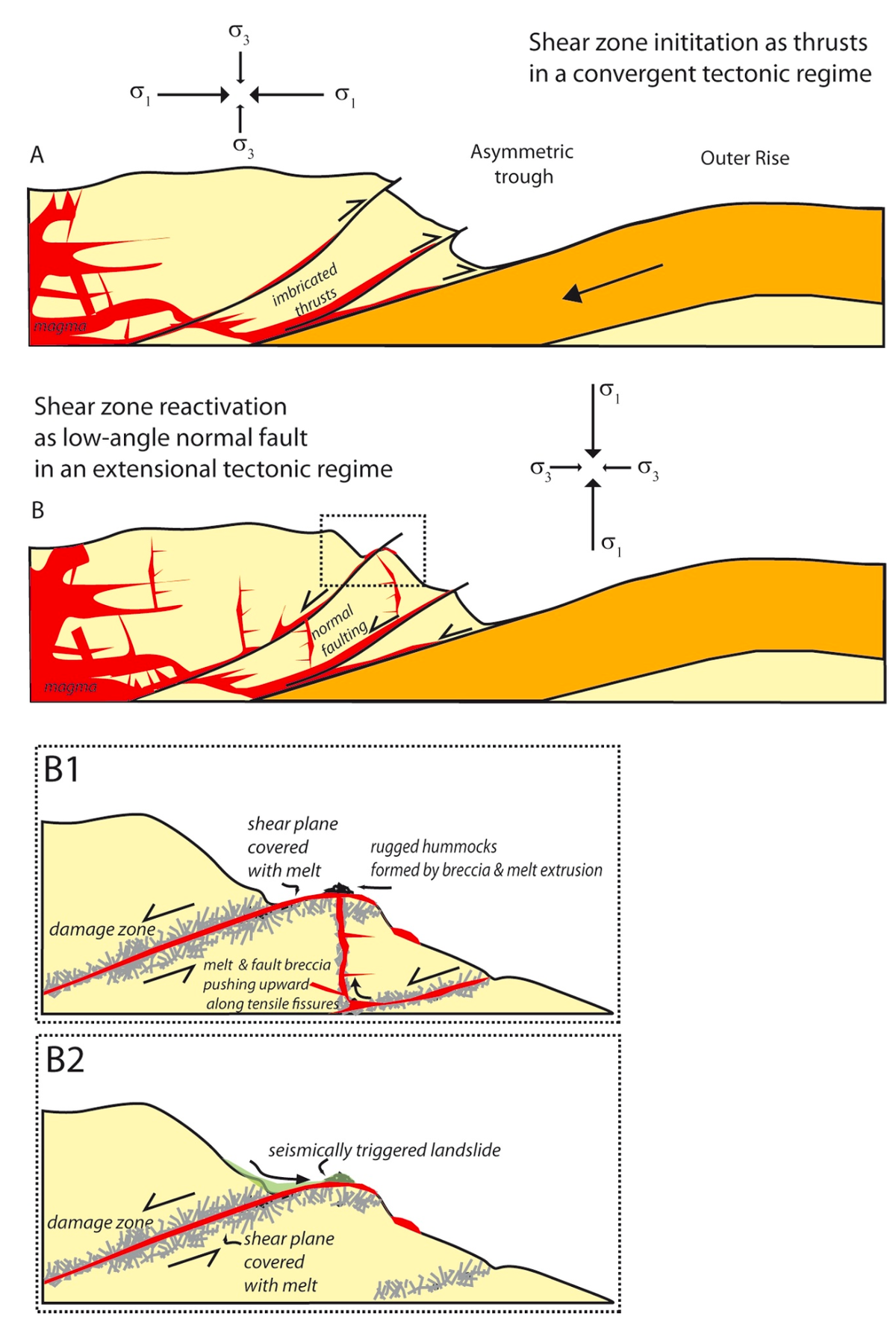
A Tale of Two Motions: When Thrust Becomes Normal
By poring over the topography and comparing these straight-line chasmata with the curved trenches that wrap around nearby coronae (circular volcanic features), we reconstructed a layered history:
Phase 1 - Compression: These faults started life as thrust faults during a spell of crustal squeezing. The asymmetric valley profiles (steep on the inside, gentle on the outside) are exactly what you'd expect from thrust faulting, much like the subduction zones on Earth where one tectonic plate dives beneath another.
Phase 2 - Extension : Then the stress regime flipped entirely. The very same faults came back to life, but now as normal faults during extension. The hanging wall (the block riding above the fault) dropped down, peeling open parts of the fault surface as those telltale terraces.
Geologists have a name for this: "negative inversion tectonics": a fancy label for faults that reverse their motion. It points to a deep change in Venus's inner workings, a swing from a convergent (squeezing) regime to an extensional (pulling-apart) one.
The Friction Problem: Too Slippery to Be Ordinary
Normal faulting at angles this shallow is a real head-scratcher. Earth's crust usually has a friction coefficient of about 0.6 to 0.8: rocks grip each other pretty firmly. To get normal faulting going at the gentle 25-37° angles we measured, you'd need friction well below that, somewhere around 0.2 or less.
So what could drop the friction that dramatically? On Earth, the usual answer is water. Fluid pressure inside a fault zone can push back against the weight of the rock above, effectively letting the fault "float" and slide more freely. But Venus has no surface water, and at 460°C any water lurking in the shallow crust should have boiled off ages ago.
We had to find another way to explain it.
Smooth Plains and Rugged Hills: The Smoking Gun
The answer started to come into focus when we noticed some unusual features sitting right on top of the fault zones. Working with both standard and inverted radar images (flipping bright and dark brings out certain details), we spotted something striking:
Radar-smooth plains: Dark patches in the radar stretching up to 300 kilometers long, seeming to pool into local lows and drape over the exposed fault terraces. These surfaces are exceptionally smooth, so smooth they barely bounce the radar signal back to the spacecraft. The way the material flows over the landscape tells me it had very low viscosity when it was laid down.
Rugged terrain : Small, isolated hills with brutally rough surfaces, often parked right in the middle of those smooth plains. They look like a mash-up of broken rock fragments (fault breccia) and solidified melt.
When we measured the microwave emissivity of these features (a window into their composition), we saw clear differences among the hanging wall, footwall, smooth plains, and rugged terrain: a sign they're made of different rock types or different surface materials.
Two Sources of Melt: Friction vs. Deep Magma
We weighed two possible origins for this melt:
Possibility 1: Frictional Melting
When faults slip during earthquakes, the friction throws off a tremendous amount of heat. If the slip is fast enough and lasts long enough, the rock can actually melt, producing what geologists call "pseudotachylite": a glassy rock born from frictional melting.
Venus should, in fact, be better at making friction melt than Earth, for a few reasons:
- Higher starting temperature : At 450°C, Venusian rocks already sit much closer to their melting points
- No water : Dry rocks are stronger and generate more friction when they slip
- Mafic composition : Venus's basaltic rocks melt at lower temperatures than Earth's quartz-rich continental rocks
We worked out that Venus should churn out roughly four times more frictional melt than Earth for faults of similar size.
There's a catch, though. Even with all that boost, the volumes of friction melt would be tiny: probably just centimeters to maybe a meter thick. That's nowhere near enough to register in radar images with 75-meter resolution. Frictional melting almost certainly happens on Venus and may glaze the fault surfaces, but it can't account for the sprawling smooth plains we're seeing.
Possibility 2: Magma from Below
The second explanation, and the one I find more convincing, is that these faults act as conduits for magma climbing up from deeper in the crust. Here's the picture:
Eastern Aphrodite Terra is dotted with volcanic edifices and sits near several large coronae: circular features raised by hot mantle plumes rising out of Venus's interior. Those coronae have partly molten guts that could double as magma reservoirs.
While the faults were active, they spun off networks of fractures (their "damage zones") around the main fault plane. Those fractures would have opened pathways for magma to creep upward from shallow reservoirs, pushed along by pressure gradients running through the fault.
As the fault moved, a slurry of magma and broken rock (fault breccia) would get squeezed upward until it reached the surface. The magma part, being runnier, would spill out and blanket the surrounding terrain, building the smooth plains. The chunkier, rocky part would pile up into the rugged hills we see.
Lubrication by Lava
Whether it's made by friction or hauled up from depth (or both), this melt does one mechanically crucial thing: it dramatically cuts the friction along the fault plane.
Melt has essentially no friction: it's a liquid, after all. Even a thin film of it on a fault surface works like oil in an engine, letting the two walls glide past each other far more easily. That's the key to how these faults could behave as low-angle normal faults despite Venus having no water at all.
And it feeds on itself: a positive feedback loop:
- Fault begins to move
- Movement opens fractures that tap into magma reservoirs OR generates frictional melt
- Melt coats the fault plane, reducing friction
- Lower friction allows continued movement at shallow angles
- More movement brings more melt to the surface
A Dynamic, Evolving Venus
Put it all together and you get a Venus that's far livelier and messier than the tidy "stagnant lid" model, where the whole crust supposedly sits frozen in place, would have you believe:
Evidence of recent activity : The crisp, unweathered look of the smooth plains and rugged terrain suggests they formed fairly recently, geologically speaking. A few areas even show what look like small landslide deposits, perhaps shaken loose by venusquakes along these faults.
Interaction between faulting and volcanism : The close marriage of faults and volcanic features hints at complex feedbacks. Earthquakes might set off volcanic eruptions by changing the pressure, while rising magma might set off earthquakes by cracking the rock above it.
Ongoing seismic activity?: If these faults really are as young as they look, they may still be capable of producing venusquakes. Going by fault scaling relationships (which tie fault size to maximum earthquake magnitude), structures like these could conceivably generate magnitude 7-8 venusquakes, though the real number rides on plenty of unknowns.
Regional vs. global tectonics : Venus has no plate tectonics like Earth's, yet it clearly undergoes serious crustal deformation driven by mantle plumes. The compression-to-extension switch we documented suggests Venus's internal dynamics can change in fundamental ways over time.
Why Strain Localizes: The Bigger Question
Underneath all this sits one of geology's deeper questions: why does deformation gather into narrow fault zones instead of smearing diffusely across the whole crust?
On Earth, the answer often comes back to water. Water weakens rocks through a handful of chemical processes and lowers friction through pore pressure. Venus, with no water to lean on, forces us to think about other ways to weaken a fault.
Our work suggests that on hot, dry planets, melt lubrication may step into the role water plays on Earth. The interplay between faulting and magmatism becomes central to understanding how a planet like that evolves.
This reaches well beyond Venus. The early Earth ran much hotter than it does now, and its crust probably behaved a lot more like Venus's. Some of Earth's oldest fault zones might have worked the same way, with melt lubrication greasing crustal deformation long before plate tectonics as we know it ever got started.
The Big Picture: Aphrodite Terra's Evolution
Pull back even further: what do these faults say about the history of Eastern Aphrodite Terra as a whole?
The region isn't just a rift zone where the crust pulled apart. It's richer than that:
- Initial convergence : Mantle plumes welling up beneath Aphrodite Terra drove compression, building thrust faults and maybe even limited subduction around the coronae
- Stress reversal : The tectonic regime flipped, perhaps as the plumes faded or as gravitational instabilities took hold
- Extensional reactivation : The old thrust faults came back as normal faults, carving the asymmetric valleys we see today
- Magma interaction : All the while, magma from plumes and shallow reservoirs traveled along the fault zones, coating them with melt and keeping the deformation going
This is not a static, dead world. It's a planet still wrestling with the consequences of its own internal heat and mantle churn, just on a tectonic framework very unlike Earth's.
Looking Ahead: Better Views Coming
We pushed the Magellan data about as far as it'll go, and that data dates back to the early 1990s. The radar images come in around 75 meters per pixel: enough to make out these major faults, but nowhere near sharp enough to confirm things like fault striations (the scratches on a fault surface that point out the slip direction) or to track small-scale changes in roughness.
Happily, reinforcements are on the way. Two new Venus missions are slated for the 2030s:
NASA's VERITAS will carry an advanced radar that should leave Magellan's capabilities in the dust, though it's been delayed.
ESA's EnVision will also fly high-resolution radar and is, for now, on schedule to launch in the 2030s.
These missions should be able to confirm or knock down our interpretations. They might even catch active faulting in the act, if any of these structures are still on the move.
Conclusion: A Planet Working by Different Rules
Venus shows us that planets can build faults, valleys, and mountains from a very different recipe than Earth's. No water, but extreme surface heat and (probably) a partly molten interior, and out of that mix Venus has cooked up its own style of tectonics, one where melt takes on the lubricating job that water handles here.
The massive faults of Eastern Aphrodite Terra, with their exposed terraces, smooth plains, and rugged hills, open a window onto these alien processes. They reveal a world that has lived through dramatic tectonic reversals, where compression gave way to extension, and where the line between solid and molten gets genuinely blurry.
The more we study our sister planet, the more I realize we're not only learning about Venus: we're learning about the whole range of ways a rocky planet can evolve, and about what Earth itself might have looked like in its hot, early youth, before water and plate tectonics reshaped it into the world we live on now.
This research was published in the Journal of Geophysical Research: Planets by Thomas Kenkmann, Oguzcan Karagoz, and Monika Gurau from the University of Freiburg, Germany.