
Following the Fault Lines on Our Sister Planet
Venus has always been called Earth's "sister planet"—similar in size, mass, and composition. But beneath its thick, toxic clouds, Venus is a world of extremes. With surface temperatures hot enough to melt lead (around 460°C) and no water whatsoever, Venus operates by very different geological rules than Earth.
In our latest research, we've been investigating massive fault zones—some stretching over 700 kilometers—that run along Eastern Aphrodite Terra, a vast highland region near Venus's equator. These aren't just ordinary cracks in the crust. They tell a remarkable story of how Venus's interior forces shaped the surface, and reveal an unexpected twist: molten rock appears to be coating these fault planes, acting as a lubricant that allows movement along remarkably shallow angles.
Giant Valleys with a Twist
Eastern Aphrodite Terra is marked by a network of deep valleys called "chasmata" (singular: chasma—Greek for "chasm"). These valleys are enormous—up to 3 kilometers deep and spanning thousands of kilometers across the region. Think of them as Venus's version of rift valleys, though as we'll see, their story is more complicated than simple rifting.
What immediately struck us when examining radar images from NASA's Magellan mission was how asymmetric these valleys are. One side has gentle slopes of about 5°, while the opposite side plunges steeply at angles up to 40°. It's like a lopsided canyon, and that asymmetry is our first clue that something unusual happened here.
Running along these steep slopes, we discovered massive shear zones—essentially giant fault planes where enormous blocks of crust have slid past each other. We mapped eight major faults with lengths ranging from 218 to 706 kilometers. To put that in perspective, the longest fault we studied would stretch from Los Angeles to San Francisco and beyond.
Faults That Dip the "Wrong" Way
Here's where things get interesting. These faults dip at shallow angles between 25° and 37°—but they dip in the opposite direction from the steep slopes where they're exposed. Imagine you're standing at the bottom of a cliff. Normally, you'd expect the fault responsible for that cliff to dip backward into the mountain. But these faults tilt forward, away from the cliff, as if they're defying gravity.
In some places, the fault planes themselves are partially exposed, forming distinctive terraces—flat steps carved into the steep slopes. These terraces reveal something crucial: the faults moved in two completely different ways over time.
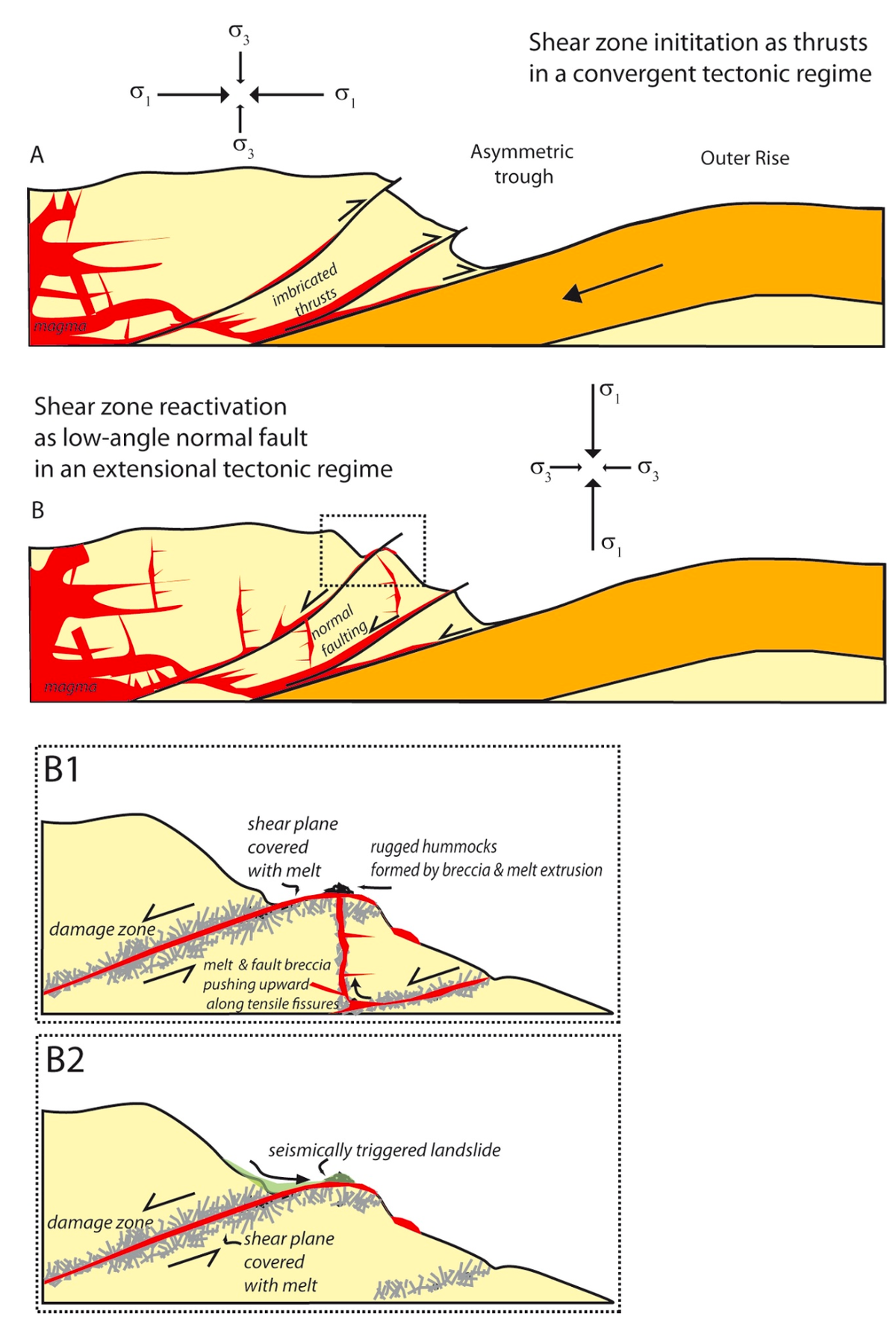
A Tale of Two Motions: When Thrust Becomes Normal
By carefully analyzing the topography and comparing these straight-line chasmata with the curved trenches surrounding nearby coronae (circular volcanic features), we pieced together a complex history:
Phase 1 - Compression: These faults originally formed as thrust faults during a period of crustal compression. The asymmetric valley profiles, with their steep inner slopes and gentle outer slopes, match exactly what we'd expect from thrust faulting—similar to subduction zones on Earth where one tectonic plate dives beneath another.
Phase 2 - Extension: Later, the stress regime changed completely. The same faults reactivated, but now as normal faults during extension. The hanging wall (the block above the fault) dropped down, exposing portions of the fault surface as those distinctive terraces.
This process is called "negative inversion tectonics"—a fancy way of saying the faults reversed their motion. It indicates a fundamental shift in Venus's internal dynamics, from a convergent (squeezing) regime to an extensional (pulling-apart) regime.
The Friction Problem: Too Slippery to Be Ordinary
Normal faulting at such shallow angles presents a major puzzle. Earth's crust typically has a friction coefficient of about 0.6 to 0.8—meaning rocks grip each other fairly tightly. For normal faulting to occur at the gentle 25-37° angles we measured, you'd need friction coefficients well below this range—somewhere around 0.2 or less.
What could reduce friction so dramatically? On Earth, the answer is usually water. Fluid pressure in fault zones can counteract the weight of overlying rock, effectively making the fault "float" and slide more easily. But Venus has no surface water, and at 460°C, any water in the shallow crust should have boiled away long ago.
We had to look for another explanation.
Smooth Plains and Rugged Hills: The Smoking Gun
The key evidence came from unusual features directly associated with the fault zones. Using both regular and inverted radar images (which flip bright and dark to enhance certain features), we spotted something remarkable:
Radar-smooth plains: Dark patches in the radar images stretching up to 300 kilometers long, appearing to flow into local topographic lows and coating the exposed fault terraces. These surfaces are exceptionally smooth—so smooth they barely reflect the radar signal back to the spacecraft. The way this material drapes over the landscape suggests it had very low viscosity when it was emplaced.
Rugged terrain: Small, isolated hills with extremely rough surfaces, often sitting right in the middle of the smooth plains. These appear to be a mixture of broken rock fragments (fault breccia) and solidified melt.
When we analyzed the microwave emissivity of these features (which tells us about their composition), we found clear differences between the hanging wall, footwall, smooth plains, and rugged terrain—indicating they represent different rock types or different surface materials.
Two Sources of Melt: Friction vs. Deep Magma
We explored two possible origins for this melt:
Possibility 1: Frictional Melting
When faults slip during earthquakes, the friction generates enormous heat. If the slip is fast enough and sustained enough, rocks can actually melt, producing what geologists call "pseudotachylite"—a glassy rock formed from frictional melting.
Venus should actually be better at producing friction melt than Earth, for several reasons:
- Higher starting temperature: At 450°C, Venusian rocks are already much closer to their melting points
- No water: Dry rocks are stronger and generate more friction when they slip
- Mafic composition: Venus's basaltic rocks have lower melting points than Earth's quartz-rich continental rocks
We calculated that Venus should produce roughly four times more frictional melt than Earth for similar-sized faults.
However, there's a problem: Even with this enhancement, the volumes of friction melt would be tiny—probably just centimeters to maybe a meter thick. That's far too small to show up in radar images with 75-meter resolution. While frictional melting probably does occur on Venus and may coat the fault surfaces, it can't explain the massive smooth plains we're seeing.
Possibility 2: Magma from Below
The second, more likely explanation is that these faults act as conduits for magma rising from deeper in the crust. Here's how this would work:
Eastern Aphrodite Terra is peppered with volcanic edifices and sits near several large coronae—circular features formed by hot mantle plumes rising from Venus's interior. These coronae have partially molten interiors that could serve as magma reservoirs.
When the faults were active, they created networks of fractures (called "damage zones") surrounding the main fault plane. These fractures would provide pathways for magma to migrate upward from shallow reservoirs, driven by pressure gradients along the fault.
As the fault moved, a mixture of magma and broken rock (fault breccia) would be pushed or squeezed upward, eventually reaching the surface. The magma portion—being more fluid—would flow out and cover the surrounding terrain, creating the smooth plains. The rocky portions would accumulate as the rugged hills we observe.
Lubrication by Lava
Whether generated by friction or transported from depth (or both), this melt would have a crucial mechanical effect: It would dramatically reduce friction along the fault plane.
Melt has essentially zero friction—it's a liquid. Even a thin film of melt coating a fault surface can act like oil in an engine, allowing the two sides to slide past each other much more easily. This is the key to understanding how these faults could operate as low-angle normal faults, despite Venus's lack of water.
The process creates a positive feedback loop:
- Fault begins to move
- Movement generates fractures that tap into magma reservoirs OR generates frictional melt
- Melt coats the fault plane, reducing friction
- Lower friction allows continued movement at shallow angles
- More movement brings more melt to the surface
A Dynamic, Evolving Venus
Our findings paint a picture of Venus as far more geologically active and complex than the simple "stagnant lid" model (where the entire crust is locked in place) would suggest:
Evidence of recent activity: The pristine appearance of the smooth plains and rugged terrain features suggests they formed relatively recently in geological terms. Some areas even show what appear to be small landslide deposits, possibly triggered by venusquakes along these faults.
Interaction between faulting and volcanism: The intimate association between faults and volcanic features suggests complex feedbacks. Earthquakes might trigger volcanic eruptions by creating pressure changes, while rising magma might trigger earthquakes by fracturing the overlying rock.
Ongoing seismic activity?: If these faults are as young as they appear, they might still be capable of producing venusquakes. Based on fault scaling relationships (which relate fault size to maximum earthquake magnitude), these structures could potentially generate magnitude 7-8 venusquakes—though the actual number depends on many unknown factors.
Regional vs. global tectonics: While Venus doesn't have plate tectonics like Earth, it clearly experiences significant crustal deformation driven by mantle plumes. The transition from compression to extension we documented suggests Venus's internal dynamics can change fundamentally over time.
Why Strain Localizes: The Bigger Question
Our study addresses a fundamental question in geology: Why does deformation concentrate into narrow fault zones rather than spreading diffusely throughout the crust?
On Earth, the answer often involves water. Water weakens rocks through various chemical processes and reduces friction through pore pressure. But Venus forces us to think about alternative weakening mechanisms.
Our work suggests that on hot, dry planets, melt lubrication may play the role that water plays on Earth. The interaction between faulting and magmatism becomes central to understanding how such planets evolve.
This has implications beyond Venus. Early Earth was much hotter than today, and its crust likely behaved more like Venus's. Some of Earth's most ancient fault zones might have operated similarly, with melt lubrication facilitating crustal deformation before plate tectonics as we know it began.
The Big Picture: Aphrodite Terra's Evolution
Zooming out, what do these faults tell us about the history of Eastern Aphrodite Terra?
The region isn't simply a rift zone where the crust pulled apart. It's more complex:
- Initial convergence: Mantle plumes rising beneath Aphrodite Terra caused compression, creating thrust faults and possibly even limited subduction around coronae
- Stress reversal: The tectonic regime fundamentally changed, perhaps as plumes declined or as gravitational instabilities developed
- Extensional reactivation: The old thrust faults reactivated as normal faults, creating the asymmetric valleys we see today
- Magma interaction: Throughout this process, magma from plumes and shallow reservoirs migrated along fault zones, coating them with melt and facilitating continued deformation
This isn't a static, dead world. It's a planet still working through the consequences of its internal heat and mantle dynamics, just on a very different tectonic framework than Earth.
Looking Ahead: Better Views Coming
Our study pushed the limits of what we can learn from Magellan data, which dates back to the early 1990s. The radar images have a resolution of about 75 meters per pixel—good enough to see these major faults, but not nearly detailed enough to confirm features like fault striations (scratches on the fault surface that indicate slip direction) or to measure small-scale roughness changes.
Fortunately, help is on the way. Two new Venus missions are planned for the 2030s:
NASA's VERITAS will carry an advanced radar that should dramatically improve on Magellan's capabilities, though it's been delayed.
ESA's EnVision will also carry high-resolution radar and is currently on schedule for launch in the 2030s.
These missions should be able to confirm or refute our interpretations. They might even be able to detect active faulting if any of these structures are still moving today.
Conclusion: A Planet Working by Different Rules
Venus shows us that planets can create faults, valleys, and mountains using very different geological recipes than Earth. Without water but with extreme surface temperatures and (probably) a partially molten interior, Venus has developed its own brand of tectonics—one where melt plays the lubricating role that water fills on Earth.
The massive faults of Eastern Aphrodite Terra, with their exposed terraces, smooth plains, and rugged hills, provide a window into these alien geological processes. They reveal a world that has undergone dramatic tectonic reversals, where compression gave way to extension, and where the boundary between solid and molten is blurred.
As we continue to study our sister planet, we're not just learning about Venus—we're learning about the range of ways rocky planets can evolve, and about what Earth might have been like in its hot, early youth before water and plate tectonics remade its surface into the world we know today.
This research was published in the Journal of Geophysical Research: Planets by Thomas Kenkmann, Oguzcan Karagoz, and Monika Gurau from the University of Freiburg, Germany.