Appearance

How the Crust of Early Mars Deformed
The circum-Tharsis wrinkle ridge system is the strongest tectonic imprint early Mars left behind. Tharsis grew into the largest volcanic province on the planet, and in building it loaded the lithosphere and redistributed stress across thousands of kilometres. The ridges are what that did to the crust.
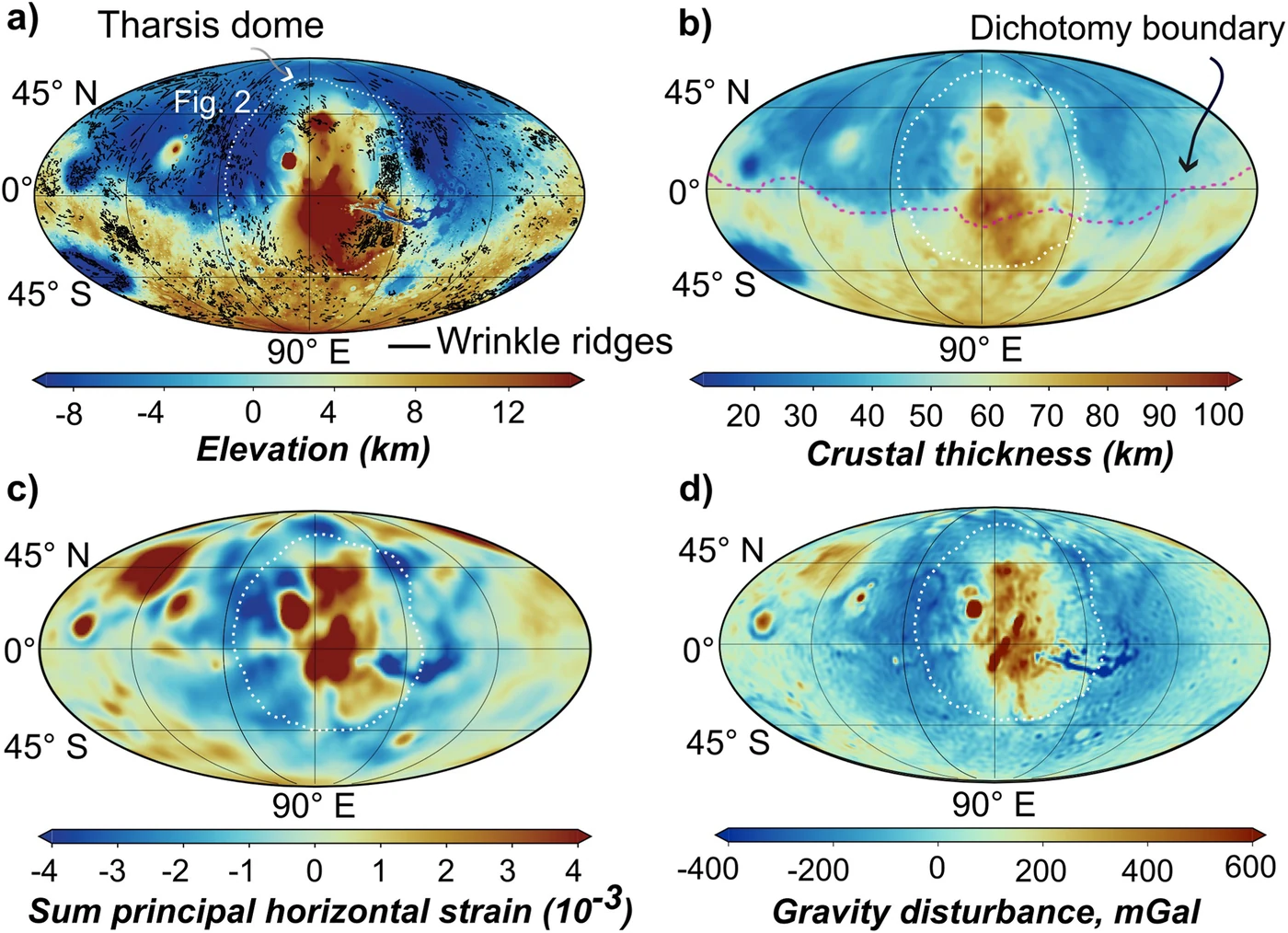
What makes the ridges useful is not that they exist but that they are organised. They are spatially coherent over enormous distances, which is not what independent local deformation produces. Coherence at that scale means a single basal décollement running laterally beneath all of it, and once you accept that, the spacing stops being a descriptive detail. The characteristic wavelength of a compressional system is set by the mechanical properties of the layer it detaches on, so the spacing is a measurement of that layer.
The question is therefore narrow and quantitative: given ridges spaced the way these are, how weak did the décollement have to be, and what could it have been made of?
The observation to be matched
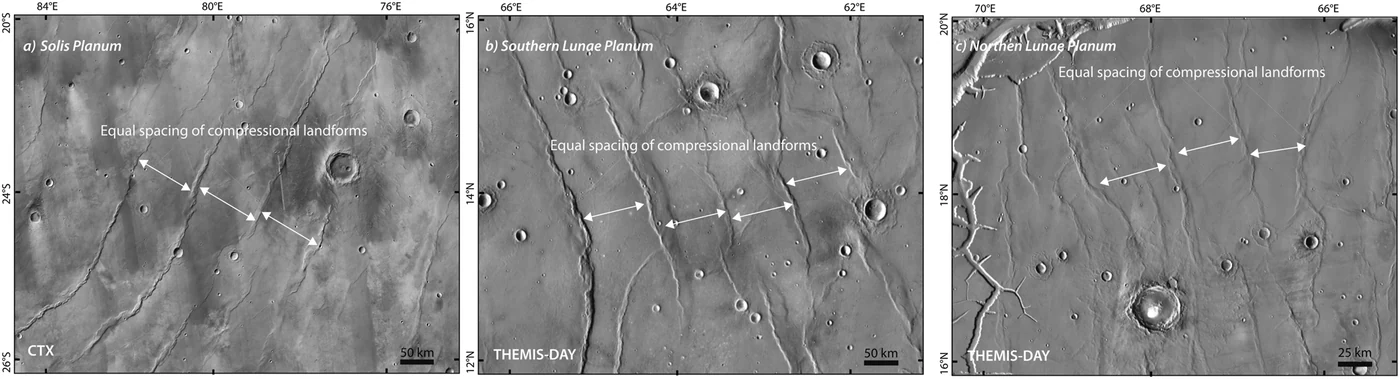
Across Solis Planum and Lunae Planum the ridges are quasi-periodic, and their spacing is about 40 kilometres. That number, together with the very low surface slopes across the province, is what any model has to reproduce.
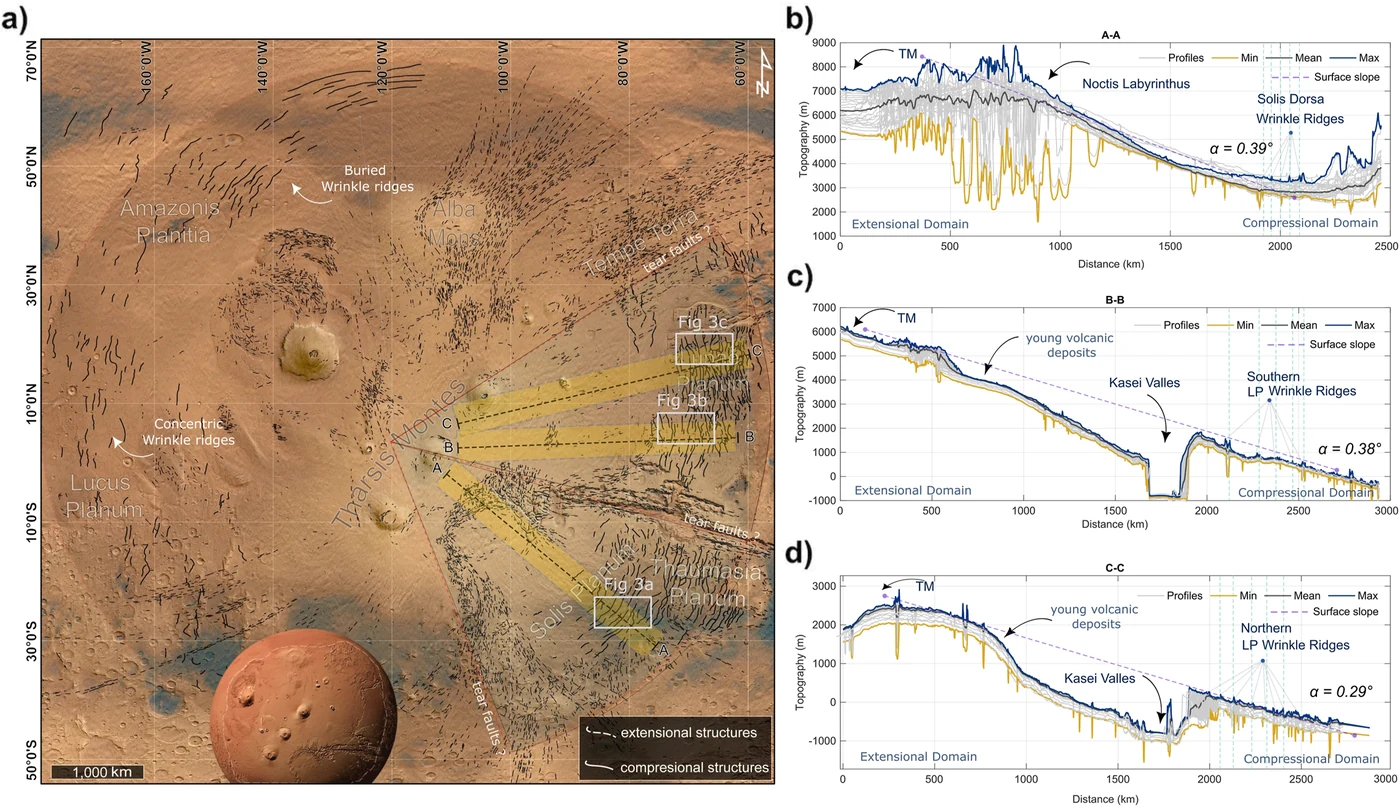
The slopes matter as much as the spacing. Swath profiles across the province run at surface slopes of roughly 0.28° to 0.38°, from an extensional domain near Tharsis to a compressional domain far out. A wedge that shallow is already a strong statement about how weak the base must be.
Two end-member rheologies
We ran thermo-mechanical models of critical-taper wedges under early Martian conditions, varying the décollement and comparing the topography and the strain pattern each one produces.
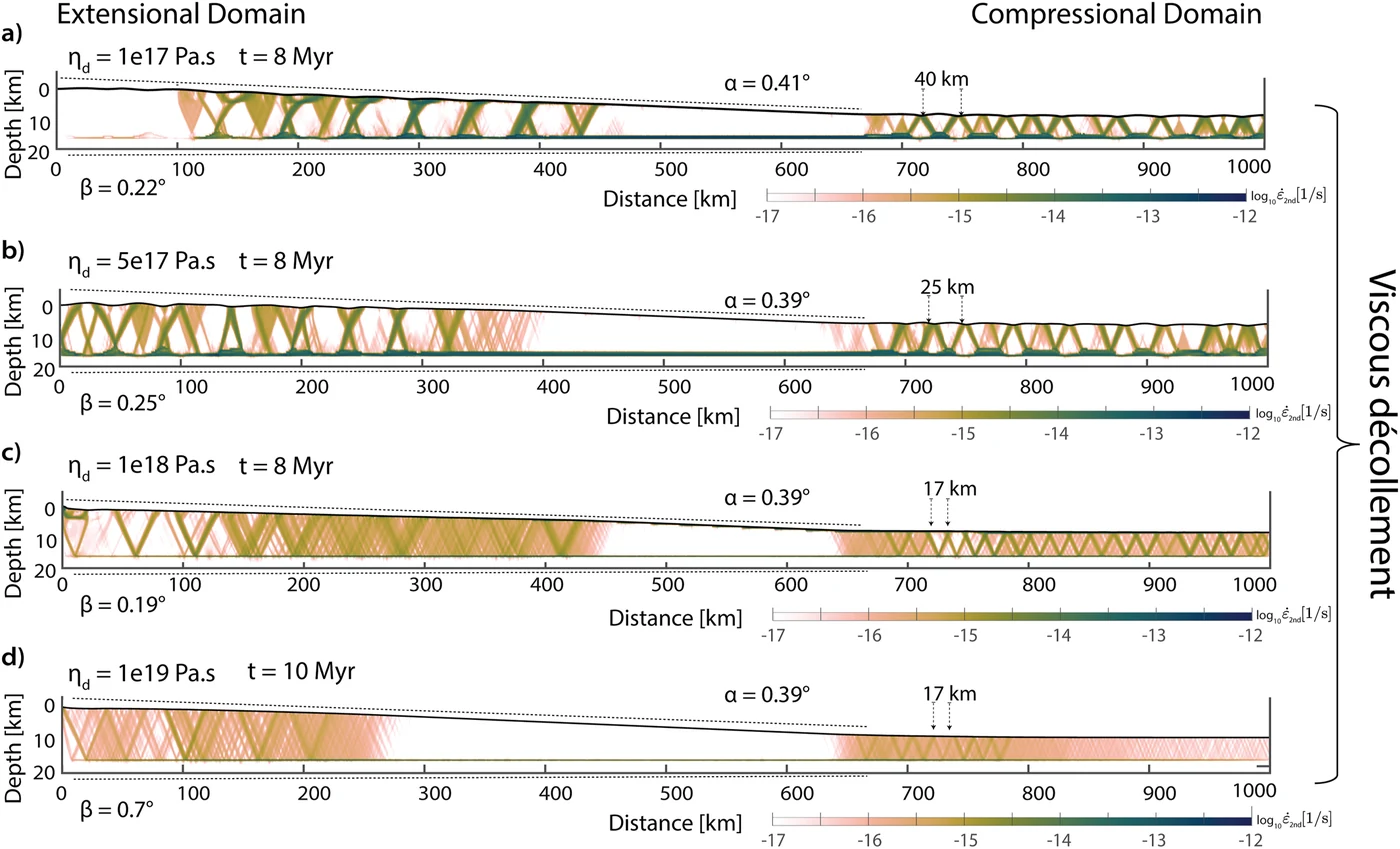
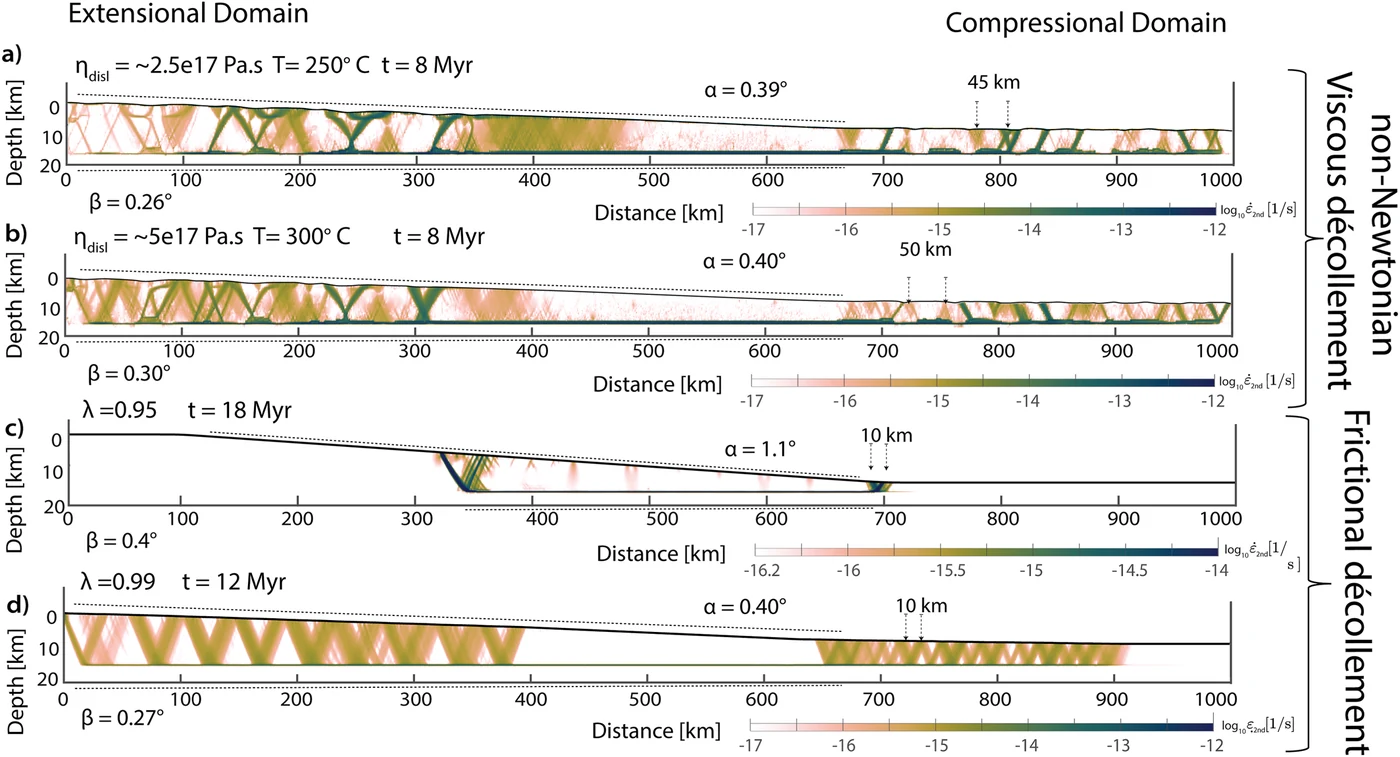
A viscous décollement was tested across four orders of magnitude of Newtonian viscosity. The result is a clean dependence: at 1 × 10¹⁷ Pa s the models produce regularly spaced ridges about 40 kilometres apart at a surface slope of 0.41°, and as the décollement stiffens the wavelength collapses, to 25 kilometres at 5 × 10¹⁷, then 17 kilometres at 1 × 10¹⁸ and above. Only the weakest cases, below 1018 Pa s, distribute stress far enough to reproduce what Mars shows.
A frictional décollement is the intuitive alternative: overpressured fine-grained material weakened by high pore fluid pressure. It fails, and it fails structurally rather than for want of tuning. A frictional layer is mechanically self-limiting. It localises strain instead of transmitting it, so even at pore fluid pressure ratios of 0.95 and 0.99 the models produce short-wavelength faulting around 10 kilometres and nothing like the observed system. Pushing the fluid pressure further does not rescue it, because the problem is that the material concentrates whatever it is given rather than passing it along.
The non-Newtonian viscous cases, at décollement temperatures of 250 °C and 300 °C, behave like the weak Newtonian ones and give wavelengths of 45 and 50 kilometres.
What that makes the layer
The bound is the result, and it is restrictive: below 1018 Pa s. The obvious candidate at that strength is salt.
That fits the rest of what is known about the period. Extensive evaporite formation on early Mars, through the Noachian and into the Hesperian, overlaps precisely with the construction of Tharsis. A salt-rich basal layer is not an exotic requirement here, it is what the surface record would lead you to expect.
It is worth being clear about what the mechanics cannot separate. Hydrothermally altered phyllosilicate sequences can also reach these viscosities, and nothing in the modelling excludes them. The argument for salt rests on the independent evidence for evaporites at the right time, not on the viscosity bound alone.
An independent check
InSight gives a way to test the depth rather than infer it. Shear and compressional wave velocity profiles from several independent analyses of the mission data show a zone of mechanical weakness at roughly 8 to 12 kilometres, a deeper discontinuity at 19 to 25 kilometres, and the brittle-ductile transition below 30 kilometres.
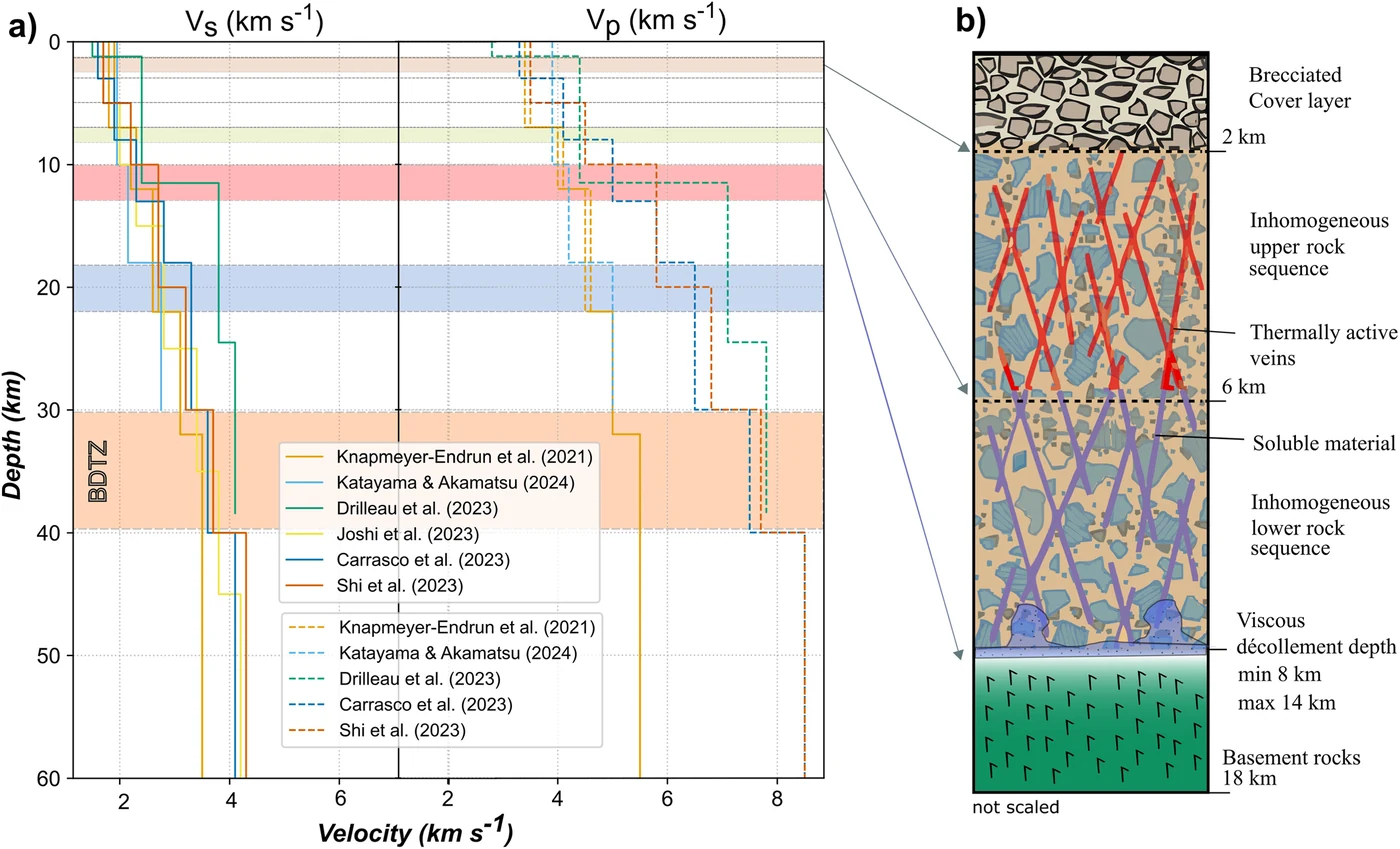
A weak layer at that depth is what the wedge models require, arrived at from seismology rather than from structure.
Why this matters beyond Tharsis
The result links two things usually studied apart: volcanic loading, and deformation thousands of kilometres away from the volcano doing the loading. What connects them is ductile flow in a weak basal layer. Without it the stress does not travel and the far-field ridges have no mechanism.
It also turns surface structure into a constraint on composition. We cannot sample the Martian crust at depth, but the spacing of features measurable from orbit bounds the viscosity of a layer kilometres down, and that bound restricts what the layer can be and what conditions made it. Reading the hydrothermal and depositional history of early Mars off the wavelength of a ridge system is indirect, and at present it is the route available.
Where it sits in the sequence
This is the fourth piece of a connected argument. The morphometric work at Lunae Planum established that these ridges root into a detachment and placed it at 2.6 to 4 kilometres depth. The subsurface study confirmed from natural cross-sections that the faults flatten with depth, as they must if they join something horizontal. The dichotomy modelling showed that reproducing Martian structures needs a viscous décollement rather than a frictional one, and quantified the contrast required.
This paper takes the same question to the whole circum-Tharsis system and uses ridge spacing, rather than individual structures, as the measurement. The four agree: the early Martian crust had a weak, laterally continuous layer at depth, it was weak enough to flow rather than merely slip, and the most likely reason is salt.
The paper. Karagoz, O., Ruh, J. B., Kenkmann, T., and Poelchau, M. H. (2026). Décollement Rheology Controls Crustal Deformation on Early Mars. Journal of Geophysical Research: Planets. doi.org/10.1029/2026JE010093
The numerical codes behind work of this kind are described on the code pages, and the laboratory experiments that test the same rheologies in a tank are on the lab page.